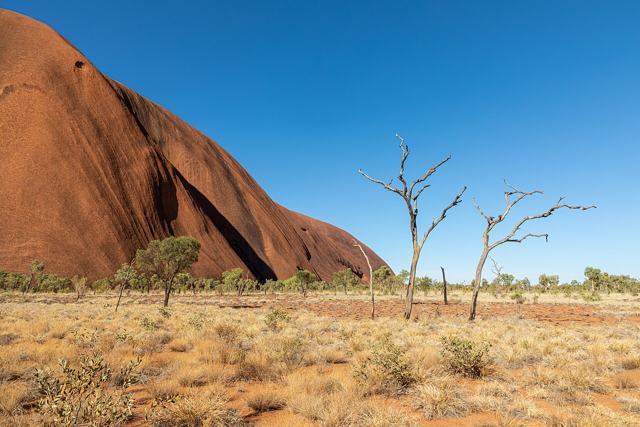
At your citizenship ceremony you pledge your loyalty to “Australia and its people”. This part explains who those people are and how Australia grew into a stable, multicultural nation.
Aboriginal and Torres Strait Islander peoples
Australia’s first inhabitants are the Aboriginal and Torres Strait Islander peoples. They have the oldest continuous cultures and traditions in the world.
65,000 years of history on one bar
The gold sliver at the end is everything since the First Fleet arrived in 1788.
Uses the earliest date given in the book (65,000 years ago).
Aboriginal peoples
- Historically from mainland Australia and Tasmania.
- Arrived between 65,000 and 40,000 years ago, according to the archaeological record.
- They believe they are central to the creation stories of this land, which begin with the beginning of time.
Torres Strait Islander peoples
- From the islands between the northern tip of Queensland and Papua New Guinea.
- Have their own officially recognised flag (see Chapter 7).
Their age-old beliefs and traditions still guide them today. They have a deep connection with the land, which they express through:
- Stories
- Art
- Dance
Indigenous cultures are diverse and an important part of Australia’s national identity. “Indigenous” means Aboriginal and/or Torres Strait Islander peoples, the First Peoples of this country. They make up about 3 per cent of the population.
- First inhabitants: Aboriginal and Torres Strait Islander peoples
- Oldest continuous cultures in the world
- Arrived 65,000–40,000 years ago
- Torres Strait: between Queensland’s tip and Papua New Guinea
- Connection to land: stories, art and dance
- More than 100 languages; about 3% of the population
European settlement and the gold rush
Follow the story from the first convict ships to the gold rush that doubled the population.
-
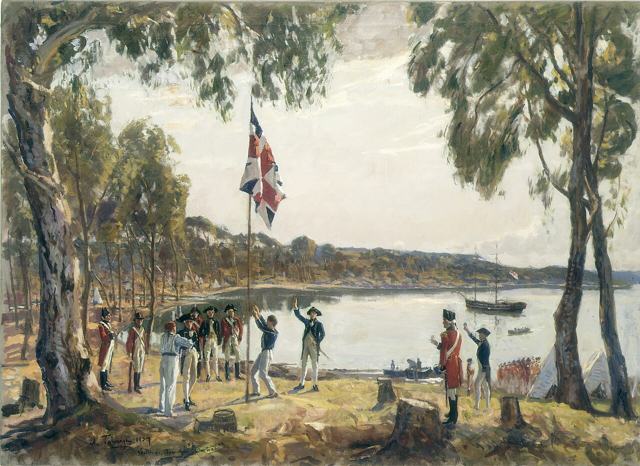 Image: Algernon Talmage, public domain · The Founding of Australia, Algernon Talmage, 1937
26 January 1788
The First Fleet arrives
European settlement started when the first 11 convict ships, known as the First Fleet, arrived from Great Britain. They landed at Sydney Cove.
-
Why convicts?
Britain’s jails were full
British laws were harsh, and the jails could not hold the large number of people imprisoned for their crimes. So the British Government sent convicts to the other side of the world, to the new colony of New South Wales.
-
The first Governor
Captain Arthur Phillip
Captain Arthur Phillip was the first Governor of the colony of New South Wales. The colony survived and grew as more convicts and free settlers arrived, and more colonies were set up in other parts of Australia.
-
Early free settlers
From Great Britain and Ireland
The early free settlers came from Great Britain and Ireland. This British and Irish heritage has had a major influence on Australia’s recent history, culture and politics.
-
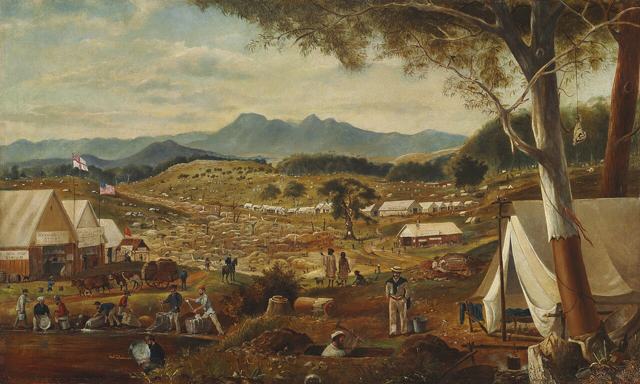 Image: Edward Roper, public domain · Gold diggings, Ararat, Edward Roper
1851
The gold rush
Gold was discovered in the colonies of New South Wales and Victoria, and people came from all around the world to try to make their fortunes.
Chinese people arriving at this time were the first large group of migrants not from Europe. In 10 years, Australia’s population more than doubled.
Watch out: three dates people mix up
1788 = First Fleet (European settlement). 1901 = Federation (the nation). 1915 = Gallipoli (Anzac Day).
How many ships were in the First Fleet?Tap to check
Who was the first Governor of NSW?Tap to check
Who were the first large non-European migrant group?Tap to check
Becoming a nation
In 1901 the separate colonies united into a federation of states called the Commonwealth of Australia.
This is when the national democratic institutions were set up: the national parliament, the government and the High Court, all under the new Australian Constitution.
In 1901 Australia’s population was about four million, not counting Aboriginal and Torres Strait Islander peoples. They were only included in official estimates of the population after a Referendum in 1967.
Three waves of migration
- First half of the 1900sMigration levels rose and fell. Programs actively encouraged British migrants to settle here, and many did.
- After World War IIA wave of non-British migration. Millions of people in Europe had to leave their homelands, and many came here to build a new life.
- Recent yearsMigration and refugee programs bring people from all over the world: to join family, make a new life, or escape poverty, war or persecution.
Australia’s population has become more diverse over the last two centuries, and this diverse, prosperous society connects Australia to the world. We celebrate that diversity while working to build a cohesive and unified nation.
English is Australia’s national language and part of our national identity.
In keeping with Australian values, migrants should learn and use English so they can take part in Australian society. Speaking English is important for making the most of living and working here. Other languages are valued too, including more than 100 distinct Aboriginal and Torres Strait Islander languages.
States and territories
The Commonwealth of Australia is a federation of six states and two mainland territories. Canberra is the nation’s capital, and each state and mainland territory has its own capital.
Tap a state on the map, or use the buttons. Yellow dots are capital cities.
All eight at a glance
New South Wales
Capital: Sydney
The first colony set up by the British. Sydney is the nation’s largest city. Icons: the Sydney Harbour Bridge and the Opera House.
Victoria
Capital: Melbourne
The smallest mainland state. Many fine buildings came from 1850s gold rush wealth. Icons: the Melbourne Cricket Ground, the 12 Apostles and the Royal Exhibition Building.
Queensland
Capital: Brisbane
The second largest state. The Torres Strait Islands lie to the north of the state and the Great Barrier Reef runs along its eastern coast. Tropical rainforests, temperate coast and an often dry inland.
Western Australia
Capital: Perth
The largest state. Mostly desert in the east; rich farming and wine-growing in the south-west; many large mining projects. Icons: the Ningaloo Coast, Margaret River and the Kimberley region.
South Australia
Capital: Adelaide
A rugged coastline and many famous wine regions. Adelaide has fine colonial architecture. Icons: the Barossa Valley and the Flinders Ranges.
Tasmania
Capital: Hobart
The smallest state, separated from the mainland by the Bass Strait. Much unspoilt wilderness. Icons: Cradle Mountain, Port Arthur and the Bay of Fires.
Australian Capital Territory
Capital: Canberra
Between Sydney and Melbourne, home of the nation’s capital. National institutions there include Parliament House and the High Court of Australia.
Northern Territory
Capital: Darwin
Tropical in the north, dry red desert in the south. Icons: Uluru, Kata Tjuta and Kings Canyon.
How big is each state and territory?
Largest to smallest by land area. The gold bar is the national capital territory.
Approximate areas from Geoscience Australia. The book gives the order (largest, second largest, smallest), not these numbers.
Watch out: popular test traps
- Largest state: Western Australia. Second largest: Queensland.
- Smallest state: Tasmania. Smallest mainland state: Victoria.
- Largest city: Sydney. National capital: Canberra.
- First colony: New South Wales.
Mini-game: which state or territory?
Pick the right one for each clue.
Welcome to Country and Acknowledgement of Country
Both traditions show respect for Aboriginal and Torres Strait Islander peoples. They sound alike, but the test may ask who performs each one.
Welcome to Country
- Performed by an Aboriginal or Torres Strait Islander custodian of the local region.
- Welcomes visitors to their traditional land. It was traditionally done so visitors had a safe and protected journey.
- Can be songs, dances, smoking ceremonies or speeches in traditional language or English.
- Usually the first item to open an event.
Acknowledgement of Country
- Recognises that the gathering is on Aboriginal or Torres Strait Islander land.
- Pays respect to Traditional Custodians, particularly Elders past and present, and to Aboriginal and Torres Strait Islander peoples who are there.
- Usually part of the welcome and housekeeping at meetings and events.
- Anyone can deliver it, usually the Chair or Master of Ceremonies.
Your citizenship ceremony may begin with a Welcome to Country from a representative of the traditional owners of the land in your area. Indigenous Australians have practised this on their traditional homelands for thousands of years.
Mini-game: Welcome or Acknowledgement?
Sort each fact.
Important days for Australians
Australia Day
A celebration
- The anniversary of the arrival of the First Fleet from Great Britain in 1788.
- A public holiday in every state and territory, and the biggest annual public holiday.
- Communities reflect on our history and celebrate every Australian’s contribution, from Aboriginal and Torres Strait Islander peoples (here about 65,000 years) to families here for generations and people from all corners of the globe.
- Events include special citizenship ceremonies.
- The Prime Minister announces the Australian of the Year Awards in Canberra.
Anzac Day
A solemn day of remembrance
- Named after the Australian and New Zealand Army Corps (ANZAC).
- The ANZACs landed at Gallipoli in Türkiye on 25 April 1915, during World War I.
- We remember the sacrifice of all Australians who served and died in wars, conflicts and peacekeeping operations.
- We honour the courage and commitment of all servicemen and women, and reflect on the many meanings of war.
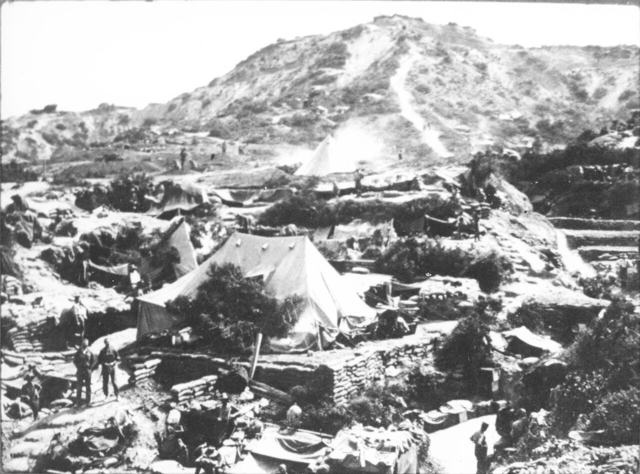
Memory hook: Australia Day celebrates (First Fleet, January). Anzac Day remembers (Gallipoli, April).
Australia’s flags
The Australian National Flag is the official flag of the nation. The Australian Aboriginal Flag and the Torres Strait Islander Flag are also officially recognised and may be flown in the community. Each state and territory has its own flag too.
Tap any part of a flag to see what it means.
The Australian National Flag
Colours: blue, white and red.
- Union Jack (top left), the flag of the United Kingdom. It represents our history of British settlement and the laws and institutions we inherited.
- Commonwealth Star (under the Union Jack). It has 7 points: one for each of the six states and one for the territories.
- Southern Cross (on the right), a group of stars that can be seen in the southern sky.
The Australian Aboriginal Flag
Colours: black, red and yellow.
- Black (top half): the Aboriginal peoples of Australia
- Red (bottom half): the earth, which has ceremonial significance
- Yellow circle: the sun
The Torres Strait Islander Flag
Colours: green, blue, black and white.
- Green stripes (top and bottom): the land
- Blue panel (centre): the sea
- Black lines: the Torres Strait Islander people
- White dancer’s headdress (centre): a symbol for all Torres Strait Islanders
- White star: its points are the island groups in the Torres Strait. The colour white symbolises peace.
Mini-game: which flag?
Match each clue to the right flag.
National symbols
The Commonwealth Coat of Arms
The official symbol of the Commonwealth of Australia. It represents our national unity and identifies the authority and property of the Commonwealth. Its parts:
- Shield in the centre: the six states and federation
- A kangaroo and an emu support the shield. Both are native animals
- A gold Commonwealth Star sits above the shield
- Golden wattle in the background
The Coat of Arms itself isn’t shown here because it can’t be freely reproduced. It’s on page 15 of the official book.
Golden wattle
Australia’s national flower: a small tree that grows mainly in south-eastern Australia, with bright green leaves and many golden-yellow flowers in spring. Each state and territory also has its own floral emblem.
Green and gold
Australia’s national colours, the colours of the golden wattle. National sports teams usually wear green and gold.
Which two animals are on the Coat of Arms?Tap to check
Where do the national colours come from?Tap to check
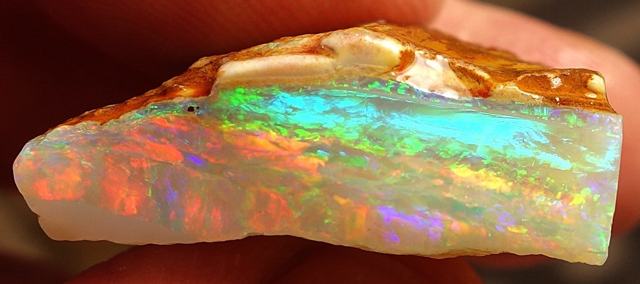
What is the national gemstone?Tap to check
National anthem
Australia’s national anthem is ‘Advance Australia Fair’. It is sung on occasions of national importance:
- Citizenship ceremonies (everyone sings it at the end of yours)
- Major sporting events
Australians all let us rejoice,
For we are one and free;
We’ve golden soil and wealth for toil;
Our home is girt by sea;
Our land abounds in nature’s gifts
Of beauty rich and rare;
In history’s page, let every stage
Advance Australia Fair.
In joyful strains then let us sing,
Advance Australia Fair.
Beneath our radiant Southern Cross
We’ll toil with hearts and hands;
To make this Commonwealth of ours
Renowned of all the lands;
For those who’ve come across the seas
We’ve boundless plains to share;
With courage let us all combine
To Advance Australia Fair.
In joyful strains then let us sing,
Advance Australia Fair.
Word help: girt by sea = surrounded by sea. Toil = hard work. Abounds = has plenty of. Renowned = famous.
Quick check: Part 1
Five random questions from this part. Click an answer to see if you’re right.
Finished Part 1?Tick it off and your progress is saved on this device.